Analysis from our core description workshop supports the initial observations made in the field – our Antarctic sediment core holds a record of an open marine environment, far closer to the centre of West Antarctica than has been seen before.
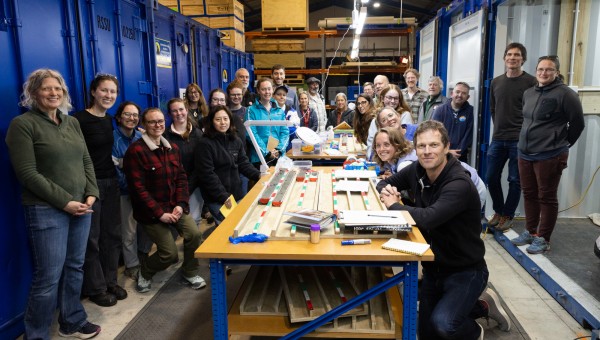
Our multi-disciplinary science team have completed their description and preliminary analysis of our 228 m sediment core, at our core description workshop at the Otago Repository for Core Analysis in Dunedin, New Zealand.
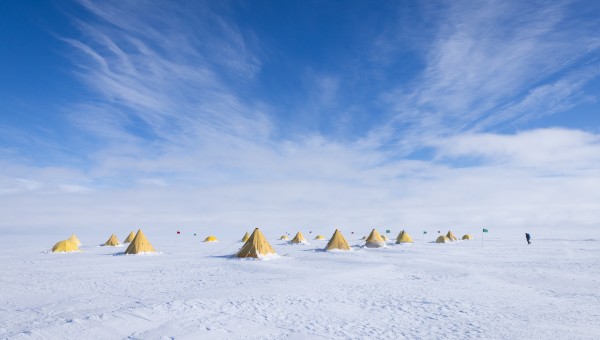
After the mammoth effort and challenges overcome to retrieve the cores from under the ice at Crary Ice Rise, there were some nerves when the saw was started up to split the first core.
“A lot of work and preparation took place before the workshop, to ensure we had the process sorted. But still there was some nervousness, followed by relief and excitement once the core was popped open and we could see it in all its majestic glory, laid out for us to start studying,” says SWAIS2C Co-Chief Scientist Professor Richard Levy (Earth Sciences New Zealand and Te Herenga Waka – Victoria University of Wellington).
“It was a very difficult drilling operation, so it’s fantastic to be here to reap the rewards of having core on the table, ready to describe, something we’ve worked so hard to achieve over the past decade,” says Professor Rob McKay (Te Herenga Waka – Victoria University of Wellington), who managed the SWAIS2C drilling operations and attended the core workshop as the sedimentology lead.
A multi-disciplinary analysis of the 228 m sediment core
The 228 m core was pulled up from under the ice at Crary Ice Rise in ‘runs’ up to 3 m long. The on-ice team processed each run into smaller sections in the field and placed it in PVC liners for easier transport and handling back to New Zealand.
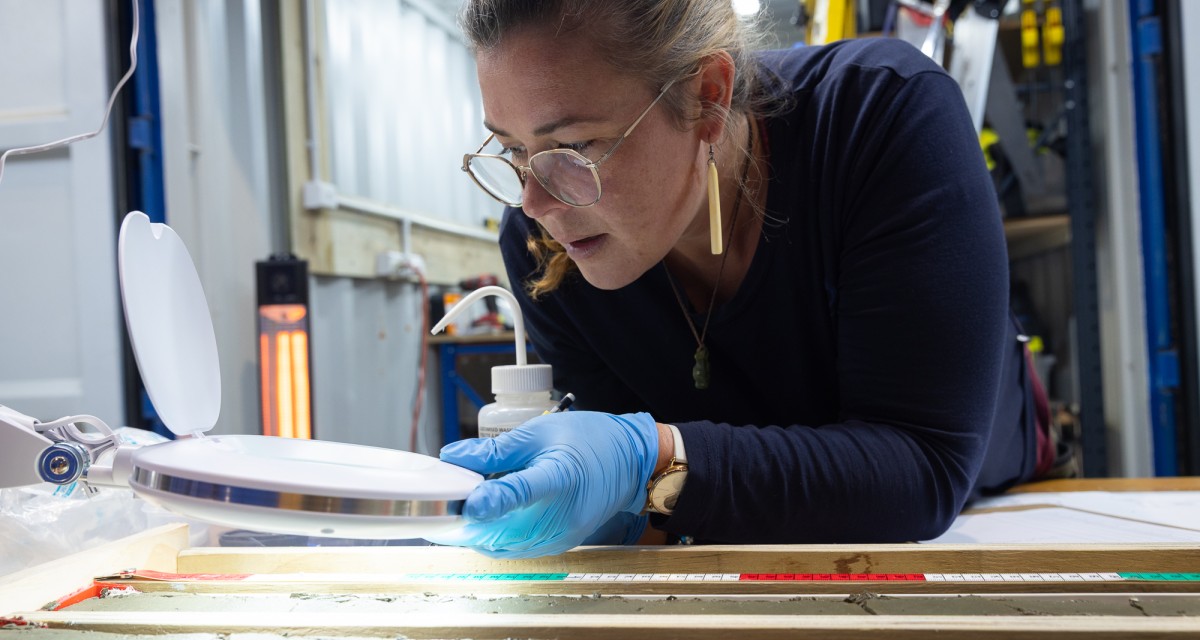
At the workshop a diamond blade saw was used to split the cylindrical core sections. The fresh core face was cleaned and prepared ready for description. One half was reserved as the ‘archive’ half and the other the ‘working’ half, available for limited sampling.
Each discipline group then carried out their description and analysis on the split sections.
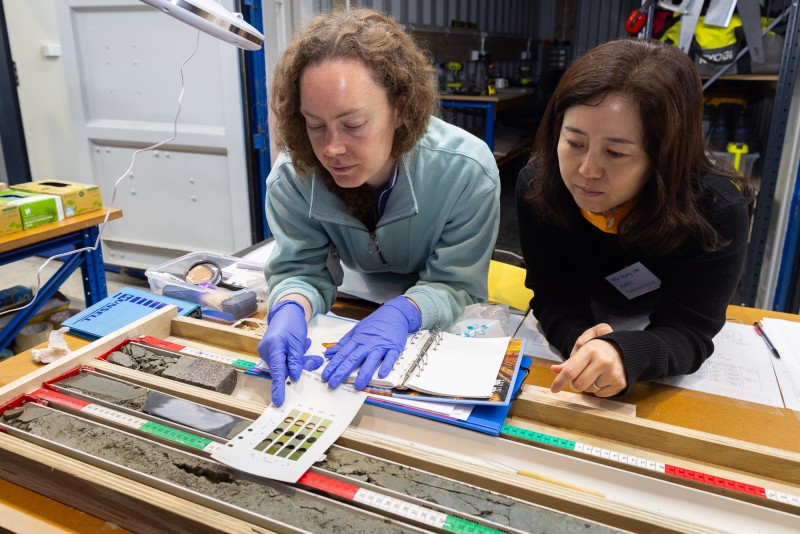
Kate Horan and Min Kyung Lee examine the core colour. Photo: Ana Tovey / SWAIS2C
The sedimentology team created detailed descriptions of the sediment grain size, colour, layering, fossil content, describing rock fragments, and noting signs of any bioturbation – little tracks left behind in the sediment by organisms burrowing through it. This information is used to build up a picture of the environmental conditions and processes at the time the sediment was deposited.
Dr Georgia Grant was part of both the on-ice team and the sedimentology team at the workshop. She says that having already seen the whole cores when they were freshly out of the ice, it is exciting to see inside the cut core.
“We get a much clearer picture when we have a cut core face. There were features that we thought we saw hints of on the outside of the core when we were in the field, and now we can see them more clearly.”

Nikola Koglin and Luca Zurli from the clastology team. Photo: Ana Tovey / SWAIS2C
The clastology team examined the clasts – little rock fragments or pebbles – in the core, describing the size and type of rock, and how they are distributed in the sediment. This can give information about where the rocks are from, and how the ice flowed in the past.
The micropaleontologists took small samples from the ‘working’ half, to process and view under the microscope. Some were looking for the remains of diatoms, a type of phytoplankton with silica shells, which can provide vital information to help date the layers of sediment. Others were on the lookout for foraminifera fossils, whose chalky calcium carbonate shells can hold useful records of past climate and environments.
Throughout the workshop the diatom experts continued to refine the age estimates based on the assemblages of diatom species they were finding. The majority of the core is now thought to be 7 to 10 million years old, with a final 20 metres at the bottom stretching back 17-19 million years.
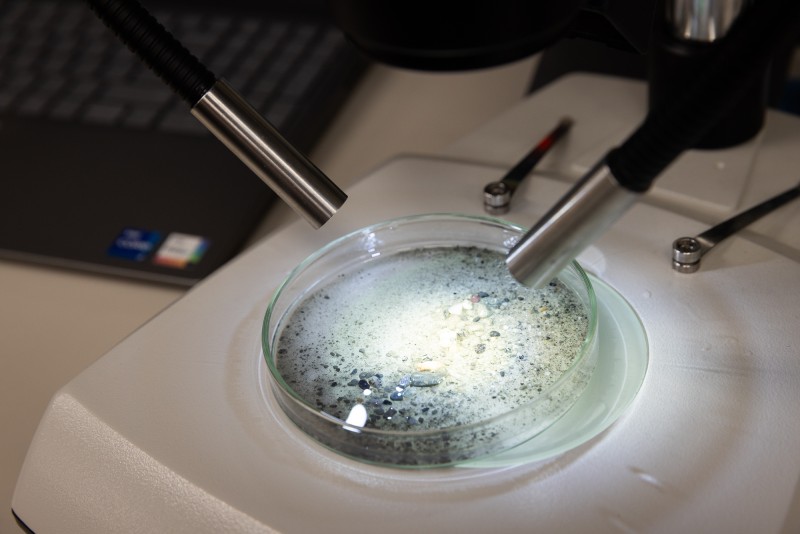
A sediment sample ready for examination for foraminifera. Photo: Ana Tovey / SWAIS2C
The paleomagnetics team took samples to look for evidence of the magnetic field preserved within the core, which will be used to further improve age estimates.
The physical properties team ran the core through various instruments for high-resolution imaging and measurement of density and other properties of the sediment, to identify layers and fragments that can’t easily be seen with the naked eye.
The wider SWAIS2C science team will use the preliminary data and observations from the workshop to guide decisions on where in the core is best to sample to answer their key questions.
Green sediments signal significant ice sheet retreat
The split cores revealed the hallmarks of past environments dramatically different from Crary Ice Rise today, where more than 500 m-thick ice currently sits on top of the bedrock.
There were sequences of very green mud, with limited sand or gravel – a clear indication of an ice free open marine environment.
The green colour is due to the high concentration of fossil diatoms in the rock, photosynthetic marine algae and can’t live in environments where ice covers the ocean and blocks the sun for long periods of time.
“It’s a surprise to find these signs of an open marine environment. We have records with similar material from closer to the modern ice shelf edge, this is the first time we've recovered such a strong indication that the ice sheet retreated at a location so close to the centre of West Antarctica,” says Levy.
The next steps will be to determine what the local temperatures were at the time that there were these open water conditions, and to understand the processes that led to the ice shelf collapse and ice sheet retreat.
Grant says that coming face to face with this visible evidence of past ice retreat is a stark reminder of the impacts of a warmer climate.
“It really sends it home that this isn’t something that’s another world away. It’s something that a warming climate is capable of producing.”